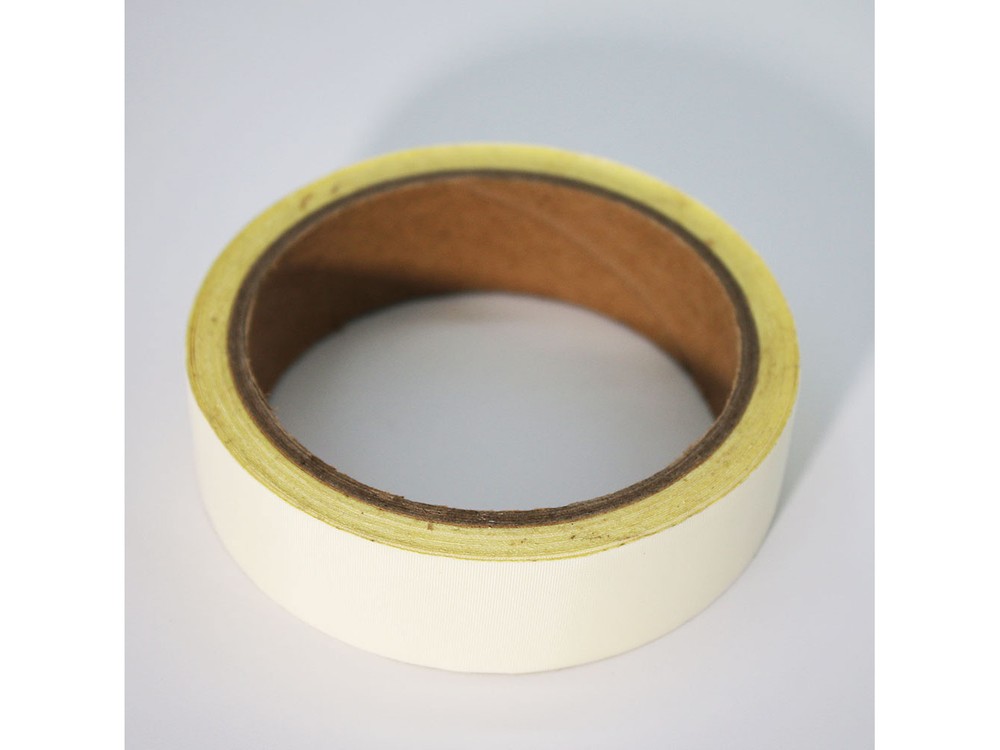
Greige or finished woven fabric, supplied uncoated. Sold uncoated to converters who apply their own adhesive, and used as the carrier under our own tapes. We weave both polyester and acetate base cloth — two different fibres, not two colours of one cloth, and we hold a separate RoHS and halogen report for each. The fibre is not printed on these datasheets, so ask which one a given code is woven from: it is what decides how the finished tape behaves.
Values in this family are measured in-house on the instruments named on each datasheet — thickness gauge, 180° peel tester, holding-power tester, ball-tack tester, dielectric tester and flammability tester. They are our own production-control readings, not third-party test results.
| Property | Value | Method |
|---|---|---|
| Colour | Black | in-house instrument |
| Total thickness | 0.10 ± 0.01 mm | in-house instrument |
| Master-roll width | 1440 mm (master roll; slit to spec) | in-house instrument |
| Mesh count | 290 T | in-house instrument |
LV 312 class: not classified. We do not estimate one from the values above — what a classification needs.
| Property | Value | Method |
|---|---|---|
| Colour | Black | in-house instrument |
| Total thickness | 0.05 ± 0.01 mm | in-house instrument |
| Master-roll width | 1460 mm (master roll; slit to spec) | in-house instrument |
| Mesh count | 380 T | in-house instrument |
LV 312 class: not classified. We do not estimate one from the values above — what a classification needs.
| Property | Value | Method |
|---|---|---|
| Colour | White | in-house instrument |
| Total thickness | 0.17 ± 0.005 mm | in-house instrument |
| Master-roll width | 1240 mm (master roll; slit to spec) | in-house instrument |
| Mesh count | 210 ± 5 T | in-house instrument |
LV 312 class: not classified. We do not estimate one from the values above — what a classification needs.
The technical data on this page is reproduced from the manufacturer's datasheet for the model named. It is for reference only and is not intended as a basis for product acceptance; for a special application, test and confirm before use.
Best-before 6 months from despatch. Store at 25 °C / 65 % RH in a cool, ventilated place, out of direct sunlight.
Two of our harness grades carry class designations on their own datasheet, with the test standard printed next to each value. The rest of the range does not, and we do not estimate a class from a peel figure or an in-house temperature reading.
| Model | Property | Value on our datasheet | Test standard cited |
|---|---|---|---|
| K8030 | temperature | −40 °C to +105 °C | LV 312 |
| K8030 | noise damping | Class C — 5 to ≤10 dB | LV 312 |
| K8030 | scrape abrasion | Class B — 100–499 cycles | ISO 6722 |
| K8030 | flammability | Class B — self-extinguishing | ISO 3795 |
| K8030 | peel adhesion | ≥ 3 N/cm | EN 1939 |
| K8030 | tensile strength | ≥ 30 N/cm | EN 14410 |
| K8030 | elongation at break | ≥ 20 % | EN 14410 |
| K75100-00 | temperature | −40 °C to +105 °C | declared on the TDS; test standard not printed |
| K75100-00 | noise damping | Class A — ≤2 dB | declared on the TDS; test standard not printed |
| K75100-00 | burn rate | ≤ 100 mm/min | declared on the TDS; test standard not printed |
An LV 312 class is the result of a specified test, not a property you can read off a datasheet. The acetate, nylon and conductive grades below report a 80 °C service temperature measured in-house on our own instruments — that is not an LV 312 temperature class, and we do not print one. Classification is done per tape model, on the construction actually supplied.
Temperature class, scrape abrasion (cited as ISO 6722 on our classified grade, and only meaningful with the mandrel diameter next to it), noise damping in dB, and flammability (cited as ISO 3795). Each is measured separately on the same model — a high temperature class says nothing about abrasion. Peel and tensile on those reports are cited to EN 1939 and EN 14410.
Tell us the model and the class your drawing calls for. We submit the construction for test and send you the report with the model number on it — we do not transfer another grade’s result onto it.
Request a classification & reportEach report covers the sample that was submitted. Where the report names a model number it is model-level; where it names a product category it covers the construction, and we say so rather than attaching it to a single model.
Master rolls are slit to your width, and we build to a drawing. Send the model and the dimension you need.
Request a quote & samples